
Lees je liever de Nederlandse versie?
The word evolution derives from the Latin verb evolvere and literally means “to unroll,” “to unwind,” or “to unfold.” Figuratively, it stands for “development,” and that is by far the most common meaning. In everyday usage the word is tied above all to a biological context.
In its biological sense, evolution is the gradual change of heritable characteristics in a population of living things, from generation to generation. A key word here is population: an individual does not evolve, but the makeup of a group’s characteristics shifts over the course of many generations. What we call “a species” today is a snapshot of a process that never stands still.
The idea of an unfolding, changing natural world was first thoroughly substantiated and described by Charles Darwin. His contemporary Alfred Russel Wallace, likewise a naturalist, arrived independently and in parallel with Darwin at virtually the same insights. The two knew each other, corresponded, and were on good terms. In 1858 their work was presented to the Linnean Society in London, a year before Darwin’s On the Origin of Species appeared. Although Darwin has come to be the one most closely associated with the theory of evolution, while Wallace always held (and accepted) a more modest place in the scientific world, their relationship remained a good one, a fine example of scientific sportsmanship.
Why attention for evolution in the Relaxicon?
The theory of evolution has fascinated me since childhood, something to read about and to learn from. Beyond that, as far as I am concerned it is impossible to look at nature and at people without feeling wonder and asking yourself how it could all have come about. Not from a need to know or an urge to understand, but truly out of open curiosity.
The evolutionary biologist Theodosius Dobzhansky is best known for his famous remark, “Nothing in biology makes sense except in the light of evolution.” I could not agree more.
Evolution ties together all the information that biologists have gathered over the ages. It lends coherence to everything from the behavior of salamanders to that of humans, from algae to orchids. As the philosopher Daniel Dennett put it, “In a single stroke, evolution connects the domains of life, meaning, and purpose to the domains of space and time, cause and effect, mechanism and physical law.”
I am inclined to think that a large part of the troubles of our time is, at its deepest level, caused by a lack of wonder and by a sense of connectedness that has come loose from its moorings. We have forgotten that we are a part of nature.
That is why, in many places on RelaxMore.net and in De Polyvagale Wereld, you will come across references to this magnificent idea. For our nervous system too, with all its layers and branches, is the product of a long evolutionary history. Anyone who wants to understand why a person reacts the way they do will sooner rather than later arrive at the question of where those reactions come from and what function they once served in our ancestors.
Biology is the foundation of psychology.
Stephen Porges
The mechanism of natural selection
Darwin’s great discovery was not that species change (others before him had already suspected as much), but how this happens, without any guiding hand. The mechanism he described, natural selection, rests on three simple conditions.
First, there is variation. No two individuals within a species are exactly alike. One hare runs a little faster, one plant tolerates a little more drought, and one bacterial strain breaks down a sugar just a bit more efficiently.
Second, part of that variation is heritable. Characteristics are passed on to offspring through the hereditary material. New variations arise continually through mutation, small and in principle random changes in the DNA, and through the reshuffling of genes in sexual reproduction.
Third, not all individuals leave the same number of offspring (differential reproduction). Those that are a little better suited to a given environment leave more descendants on average, and thereby pass on their heritable characteristics more often.
The result follows of its own accord: characteristics that confer an advantage in a given environment become more common over the generations, and disadvantageous ones become rarer. The environment “chooses,” as it were, not consciously, but simply because some variants come through better than others. That continual pressure of circumstances is what we call selection pressure.
It is tempting here to lapse into purposeful language, as if a species “evolves in order to” survive better. That is misleading. There is no plan behind it and no striving toward a particular goal. The variation arises blindly, and only afterward does it become clear which variants fared better in a given environment. The direction we think we see in hindsight is a pattern that the process builds up, not a destination it is working toward.
And selection is not the whole story. Part of the change rests on pure chance, especially in small populations. This phenomenon is called genetic drift: heritable variants can become more or less common without conferring any advantage or disadvantage, simply because the lottery of who reproduces is a capricious one. Evolution leaves room for both selection and chance.
And there is yet another force at play that is not directly tied to the environment: sexual selection. Here it is not survival in the direct sense that matters, but the finding of a mate. Characteristics that increase the chance of reproduction can spread even when they are disadvantageous for survival. The heavy, showy tail of a peacock is the well-known example: it makes the bird more vulnerable, yet is maintained because it has drawing power. So it can happen that the one advantage, a greater chance of offspring, is at odds with the other, namely a greater chance of survival.
What Darwin could not yet know
Darwin described the mechanism convincingly, but he did not know what heredity was made of. The work of the monk Gregor Mendel on hereditary factors in peas had in fact already been published in Darwin’s day, but was still little read. Only in the first decades of the twentieth century was Mendel’s genetics rediscovered and, in the 1930s and 1940s, fused with Darwin’s theory of selection into what came to be called the modern synthesis. After that, from the unraveling of the structure of DNA in 1953 onward, the story gained a molecular underpinning that Darwin could not have imagined.
The beautiful thing is that all this later evidence did not overturn Darwin’s core idea but confirmed and deepened it. Today we can read the kinship between species in the very letters of the DNA. Humans and chimpanzees share about 98 percent of their hereditary material, which is exactly what you would expect of two lineages that diverged from a common ancestor only some seven million years ago.
Another insight unknown to Darwin: the cells we are made of themselves carry the traces of an ancient fusion. The mitochondria, the power plants of our cells, almost certainly descend from once free-living bacteria that were taken up by a larger cell more than a billion years ago and stayed there. This theory of endosymbiosis, made famous above all by the work of Lynn Margulis, means that every cell in your body carries a memory of that ancient merger. Fascinating!
Deep time
One of the hardest things to truly grasp is the span of time over which all this plays out. The Earth is about 4.5 billion years old, and the first life arose as long ago as 3.5 to 4 billion years. Against such figures, every human power of imagination pales. What seems impossible within a single lifetime becomes plausible over thousands, millions, and billions of generations. Evolution is in no hurry, and it is precisely that unimaginable quantity of time that is one of the quiet leading players in the whole story.
The evidence for evolution
The evidence for evolution is still growing, and it has never been stronger. What is remarkable is that it comes from entirely independent quarters and time and again yields the same picture. A few of these lines of evidence deserve to be singled out.
Fossils
The rock layers preserve an ordered succession of life forms, with transitional forms that show the connection between major groups. A fine example is Tiktaalik, a fossil around 375 million years old that combines features of both fish and the first land animals. The striking thing is that, based on the theory of evolution, researchers predicted in which layer and which type of rock they ought to find such a transitional form, and then went looking there. And they found it! A theory that makes such predictions possible is doing what a good theory is supposed to do.
Comparative anatomy
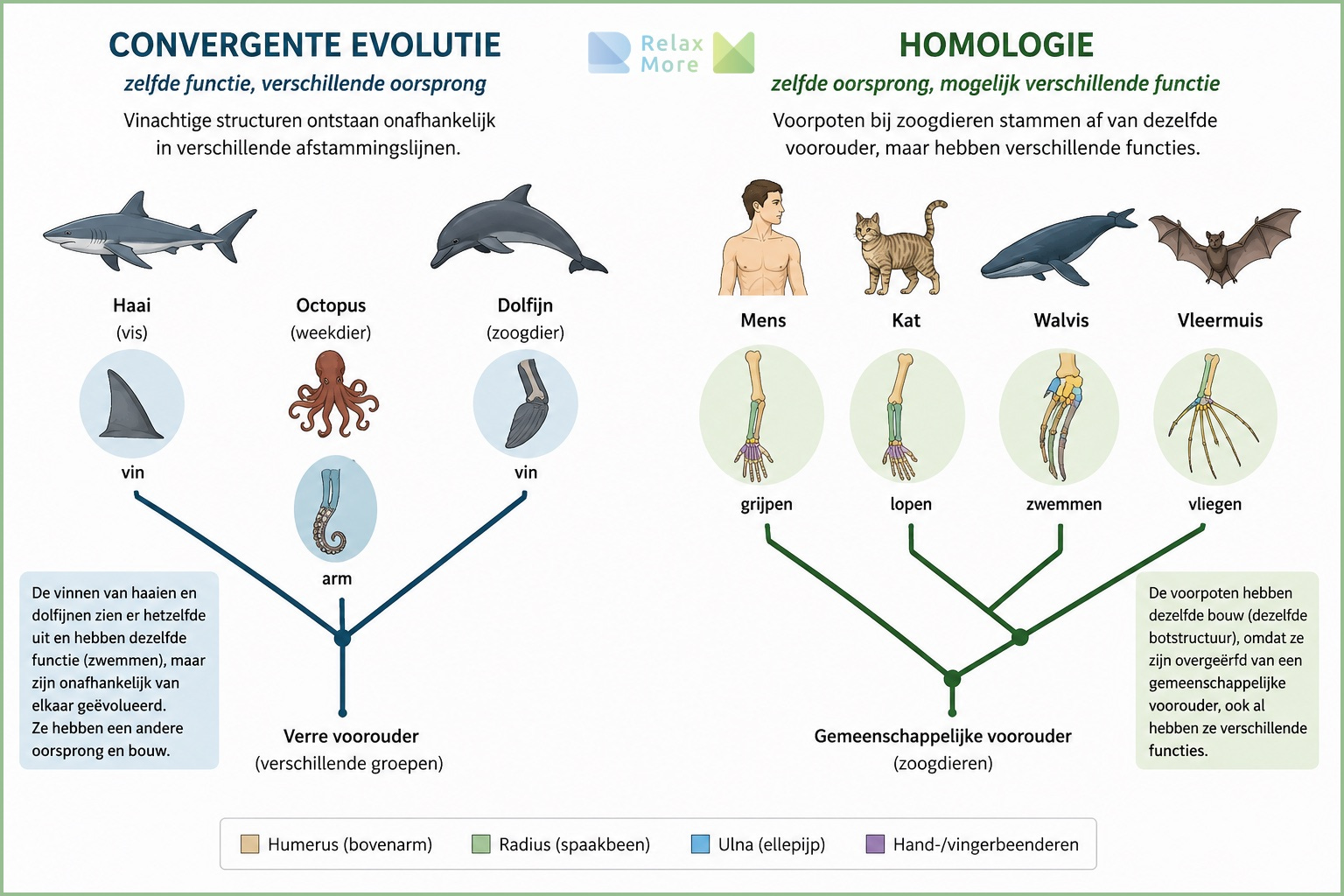
The body plans of widely differing animals betray a shared ancestry. The skeleton of a human arm, a bat’s wing, a whale’s flipper, and a horse’s leg is built from the same bones in the same arrangement, only worked out differently each time. Such similarity through descent we call homology. More telling still are the uneconomical detours that no designer would choose, but that can be explained as an inheritance from a distant past. A wonderful example, and one close to my own interest in the vagus nerve, is the recurrent laryngeal nerve. This branch of the tenth cranial nerve runs down from the head, forms a loop low in the chest around a large artery, and then travels all the way back up to the larynx. In humans, that is already a curious detour, but in the giraffe, that same detour spans several meters. No engineer would route a cable like that. As an inheritance from a fishlike ancestor, in which that same nerve still took a short, straight path, just behind one of the branchial arch arteries, the pattern falls completely into place.
Embryology and molecular biology
Early embryos of very different vertebrate animals look strikingly alike, and in the DNA of species we read off a family tree that corresponds remarkably well with the tree that fossils and anatomy suggest.
Three utterly different sources, and time and again the same pattern of connection and kinship.
Evolution in our time
Perhaps the most convincing evidence of all is that we can observe evolution directly. Bacteria that become resistant to antibiotics are a daily and worrying example of selection at work. On the Galápagos Islands, Peter and Rosemary Grant tracked ground finches for decades and measured how the average beak shape of a population changed measurably in dry and wet years, sometimes within a few generations. And in a laboratory, the biologist Richard Lenski has been following a population of the bacterium E. coli since 1988, generation after generation. After more than twenty years, somewhere around the thirty-one-thousandth generation, one of the lines developed the ability to use a nutrient that its ancestors could not. Evolution recorded as it happens.
Thanks to Richard Dawkins, who, among other places in his wonderful book The Greatest Show on Earth, brings precisely these lines of evidence together in masterly fashion. I cannot, of course, reproduce his entire book here, but it is well worth buying for yourself. As is the rest of his work, for that matter.
Convergence, divergence, and exaptation
When you look at life from a distance, recurring patterns stand out in the way evolution proceeds.
Sometimes species with a common ancestor drift apart because they end up in different environments. That is called divergence. The Galápagos finches, all descended from a single ancestral species but by now with very different beaks, are a textbook example of this.
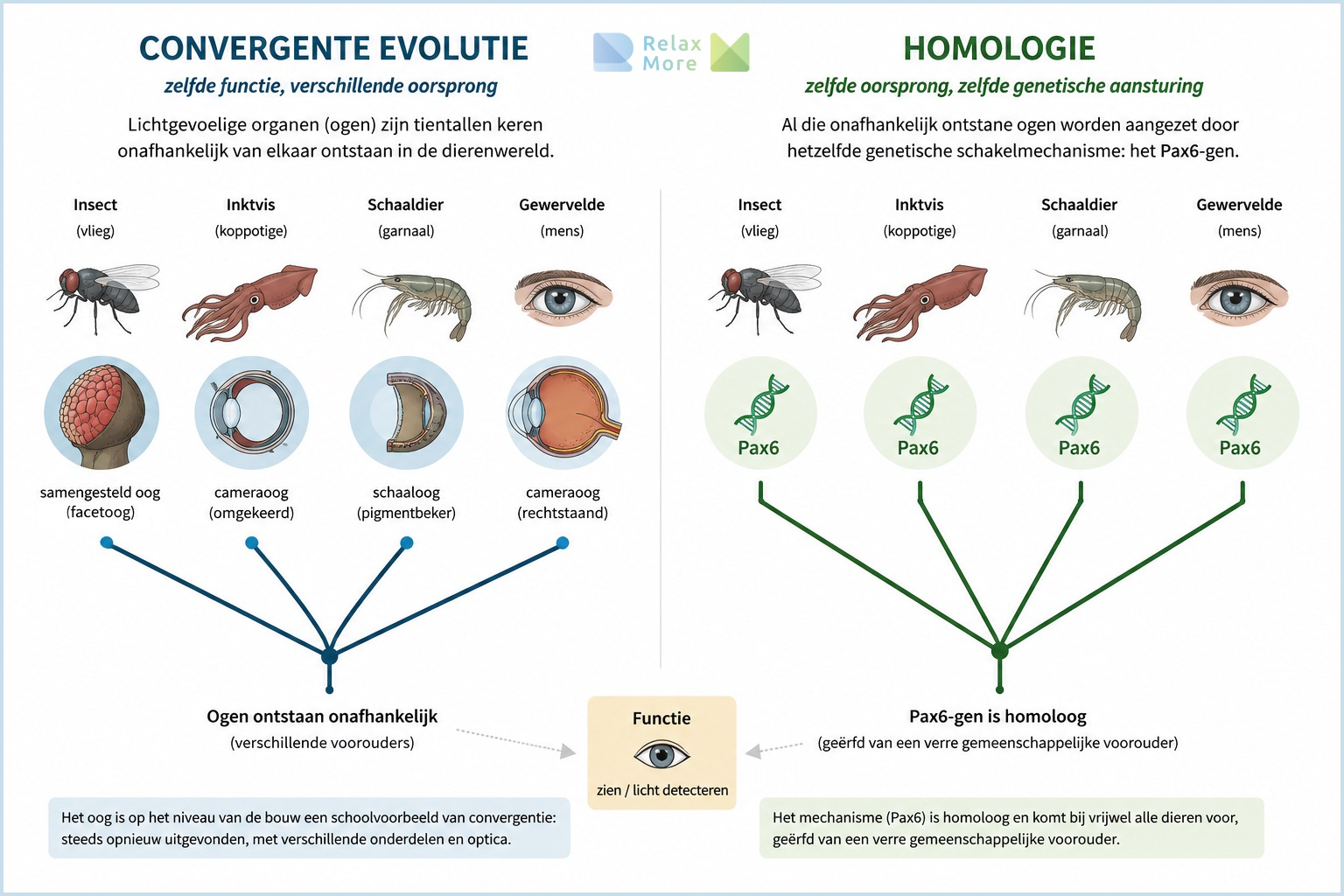
The reverse also occurs. Species that are not closely related at all develop, independently of each other, strikingly similar solutions to the same problem. That is called convergence. The eye of a squid and that of a mammal closely resemble each other, even though their common ancestor had no camera eye. Comparable circumstances, in this case an advantage to sharp vision, lead along different roads to comparable outcomes.
Particularly fascinating and particularly relevant for understanding our nervous system is the phenomenon of exaptation. Here a trait that once arose under a particular selection pressure (or that at first had no clear function at all) takes on an entirely new function at a later stage. Feathers are the classic example. They almost certainly did not arise for flight but were initially served, most likely, for heat insulation or for display and were only put to use for flying much later. The building blocks were already there, and evolution redeployed them for something else. This pattern, in which old structures take on a new role, surfaces again and again when we try to understand the history of the nervous system, and it is precisely why the concept of exaptation is dealt with more fully in an article elsewhere on this site.
A few stubborn misconceptions
Evolution is one of the best-substantiated theories in all of science, and yet stubborn misconceptions about it persist. Let me set a few of them straight.
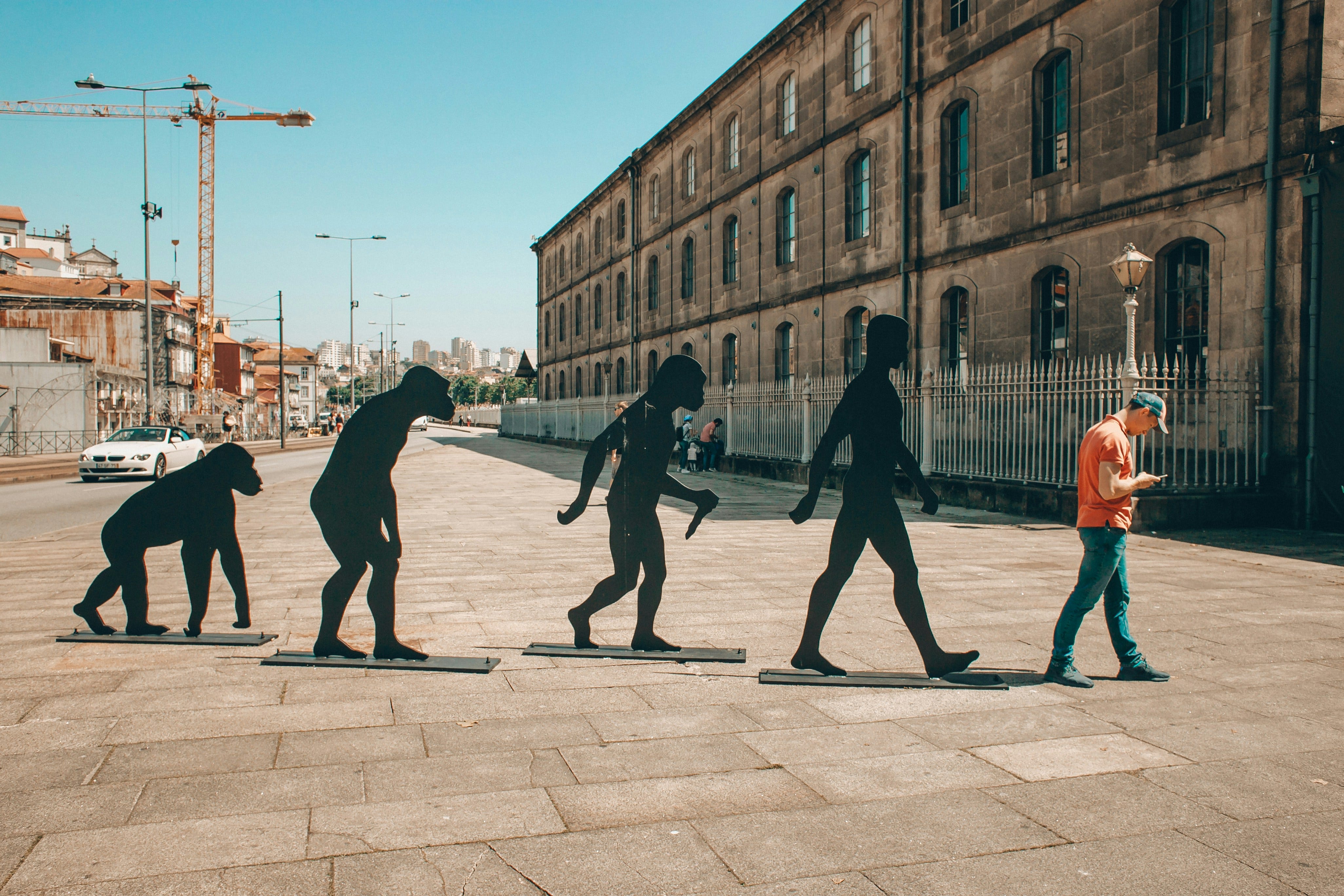
Evolution is not a ladder and not progress. The image of a row of figures developing from a stooped ape into an upright walking human (see above) is misleading. Evolution does not proceed as a march toward a higher goal, but as a branching shrub. Humanity is not the end point or the crown of creation, but one little twig on an unimaginably rich tree, of which bacteria, fungi, and plants are just as much present-day branches.
Evolution strives toward nothing. Evolution has no goal and no providence. Characteristics arise without the future playing any part in it. That we often see, in hindsight, a fine attunement to the environment does not mean that this attunement was aimed at.
And “survival of the fittest” does not mean “the strongest wins.” By “fit” is meant not strength or health, but the degree to which an individual manages to leave offspring in its specific environment. Sometimes cooperating, staying small, or being inconspicuous is the most successful strategy. It is about fitness to the circumstances, not about brute force. So it is the “best adapted” that survives.
Evolution is not “just a theory.” In everyday usage, “theory” means something like a guess or a hunch, and in that sense, evolution is sometimes dismissed as merely one opinion among others. In science the word means precisely the opposite: a theory is a coherent explanatory framework that is supported by a mountain of evidence from countless directions and that has been tested successfully time and again. Gravity, in that sense, is also “just a theory.” Evolution is not a loose supposition but one of the best-substantiated explanations that science possesses.
Evolution does not necessarily stand opposed to faith. The opposition between evolution and religion is often presented as sharper than it is. Countless biologists are religious, and many faith communities accept the theory of evolution without any difficulty. The friction that sometimes flares up is not about science versus faith as such, but about evolution versus a strictly literal reading of a creation story. Evolution explains the how, not the what for. Whoever demands that it also answer the latter is asking for something it was never meant to provide, and whoever rejects it because it does not do so is reproaching it for something it never promised.
Tree of life
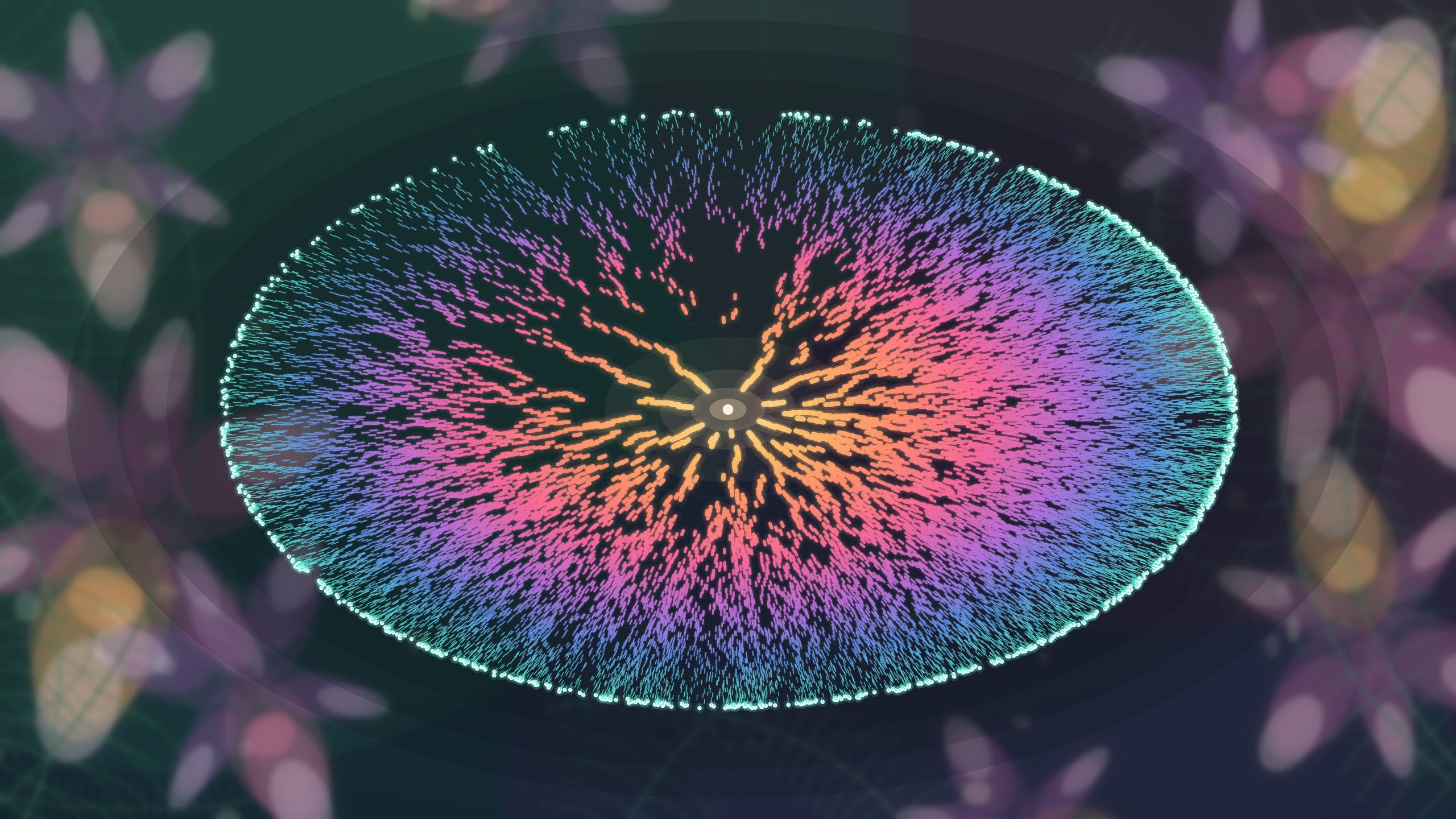
The tree of life renders all these kinships as one great, branching structure, as you can see in these two examples.
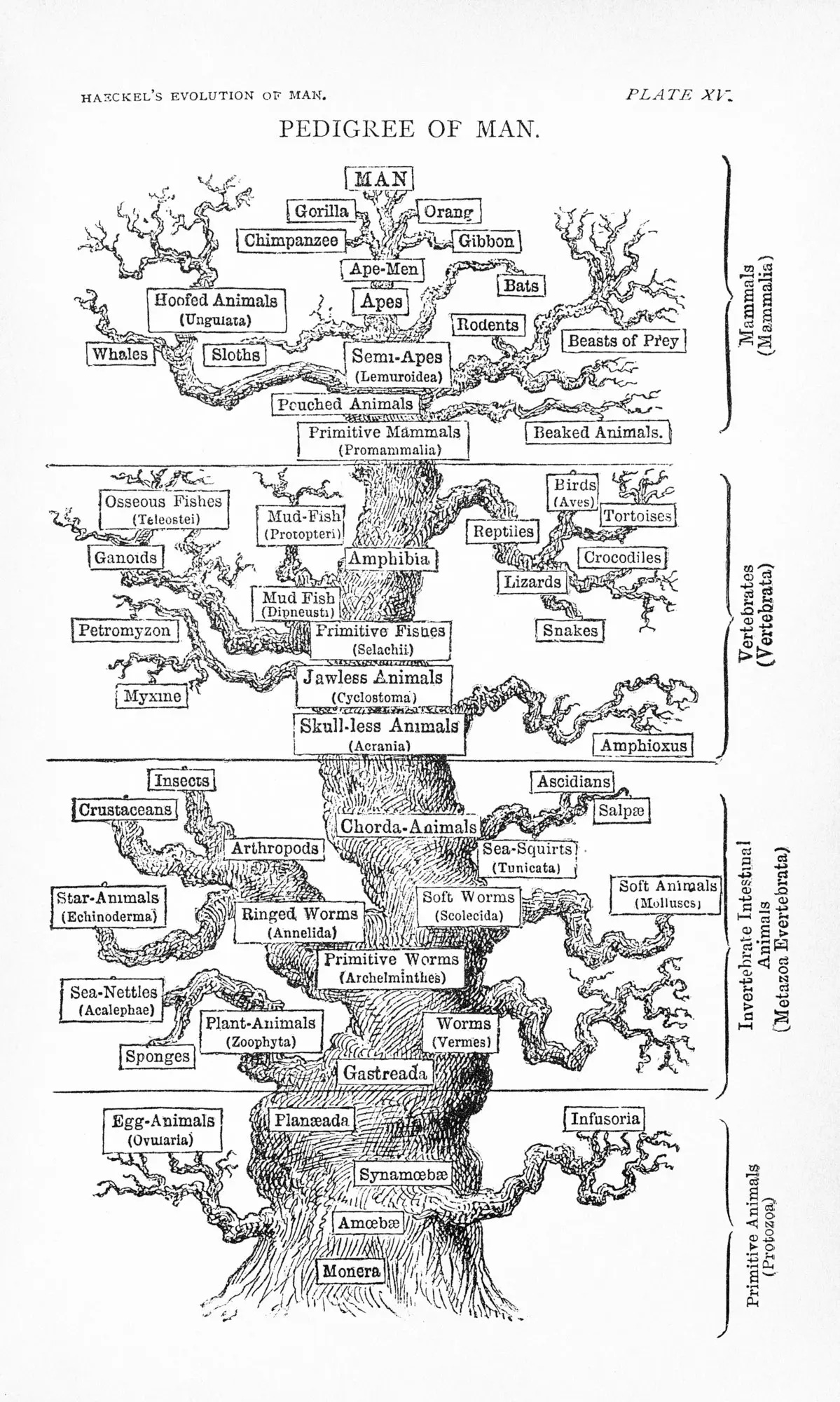
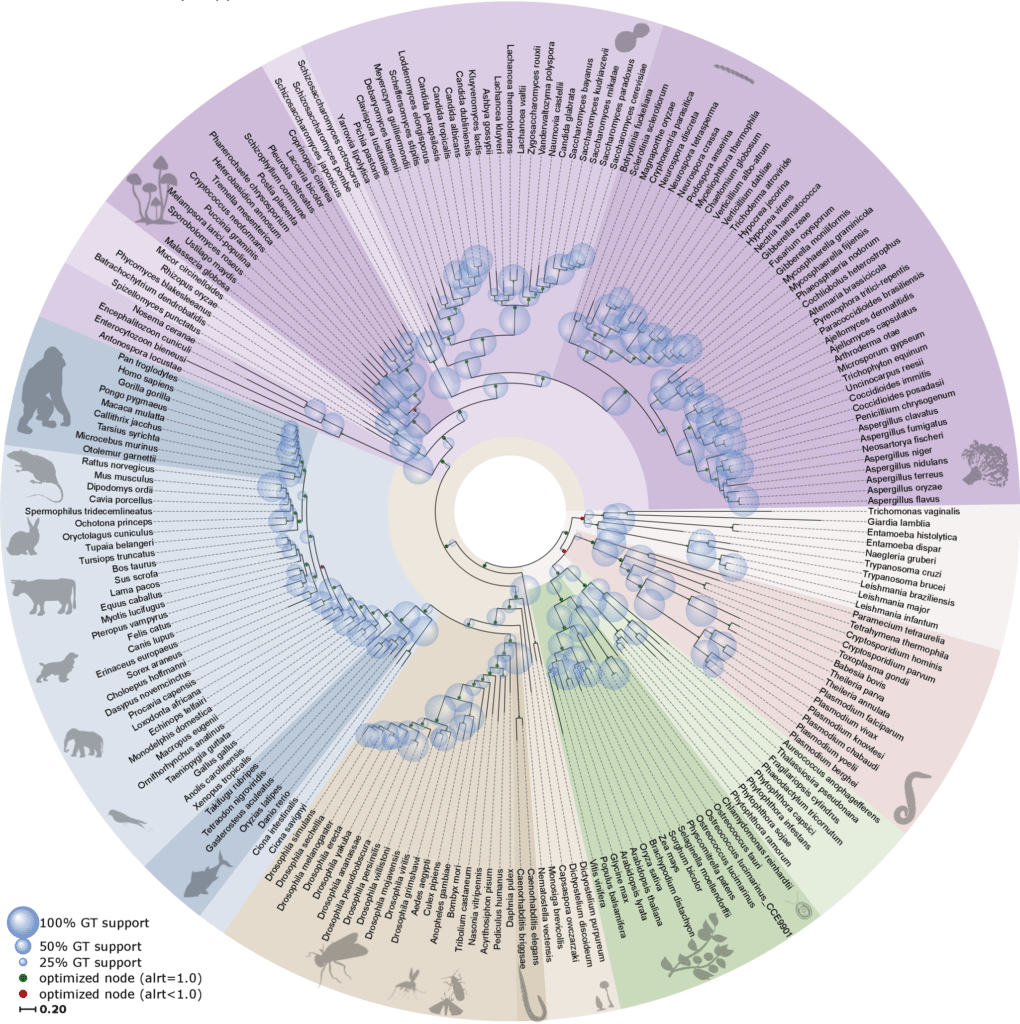
For more beautiful images, see Wikipedia.
Glossary
Adaptation
A heritable trait shaped by natural selection that confers an advantage in a particular environment. The word is also used for the process by which such a trait arises. Important: an adaptation is attuned to the circumstances under which it was shaped in the past, and so need not fit the present environment perfectly.
Analogy
The outcome of convergence: a similarity between traits of species that does not rest on common descent, but on independent adaptation to comparable circumstances. Analogy is thus a property of the comparison, something you establish when you place two species side by side. The wing of an insect and that of a bird are analogous: they serve the same purpose but have a different origin. The opposite concept is homology, where the similarity does rest on common descent.
Convergence
The process that leads to analogy: species that are not, or barely, related develop similar traits independently of each other because they face comparable challenges. Where analogy describes the outcome, convergence describes the road toward it. The camera eye of squid and mammal is an example of this: twice, independently, a comparable eye, from an ancestor that did not yet have one.
Divergence
The growing apart of species or populations that share a common ancestor, as they change in different directions. Often the result of inhabiting different environments.
Exaptation
The phenomenon in which a trait that originally arose under a different selection pressure (or had no clear function at first) is later put to use for a new function. Feathers, probably first for insulation and later for flight, are the classic example. The term was proposed in 1982 by Stephen Jay Gould and Elisabeth Vrba. Read more in this article.
Extinction
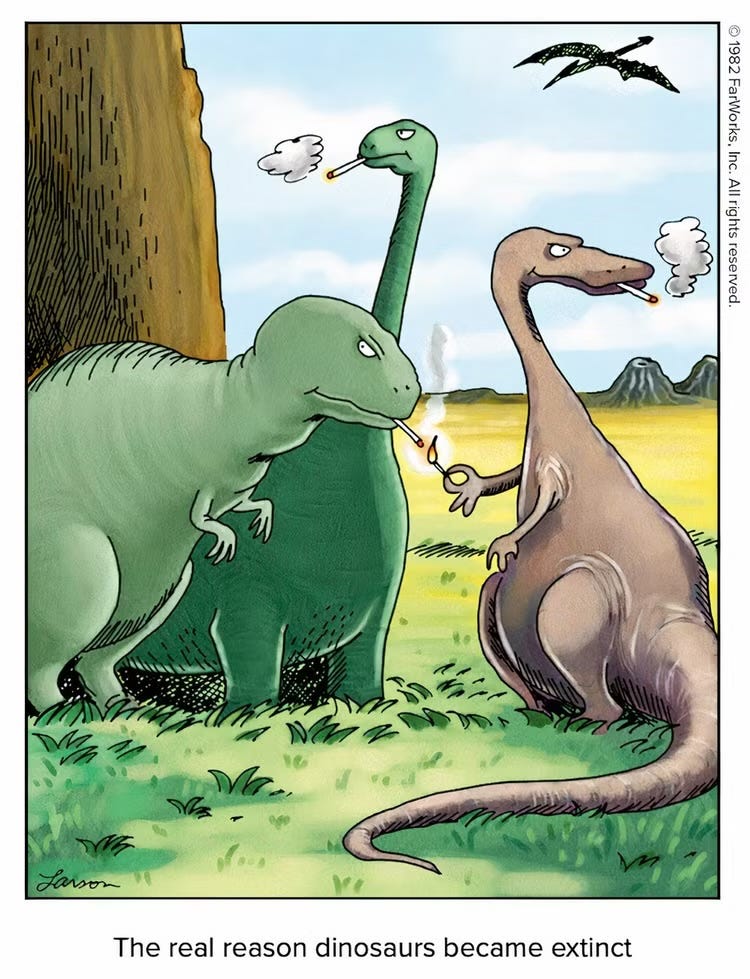
The complete disappearance of a species or larger group, when the last individuals die without leaving offspring. Extinction is not the exception but the rule: by far the most species that have ever existed are now gone. It is therefore a shaping force in evolution, continually pruning branches from the tree of life. Sometimes this happens gradually, sometimes in short, violent waves that we call mass extinctions. Such events do not only clear away, they also make room: only after the disappearance of the dinosaurs could the mammals truly come into their own.
Genetic drift
Change in the frequency of heritable variants in a population through pure chance, apart from any advantage or disadvantage. The effect is strongest in small populations and serves as a reminder that not all evolution is driven by selection.
Homology
Similarity between traits that does rest on common descent, regardless of whether the function is still the same. The bones in a human arm, a bat’s wing, and a whale’s flipper are homologous. The counterpart of analogy.
Mutation
A change in the hereditary material (DNA). Mutations arise in principle at random and form the ultimate source of all new heritable variation. Most are neutral or harmful; a small minority turns out to be advantageous in a given environment.
Natural selection
The core mechanism of evolution: because heritable variants differ in the extent to which they make offspring possible, advantageous variants become more common over the generations in a given environment and disadvantageous ones rarer. No conscious choice is made, then; it is a consequence of greater or lesser reproductive and survival success.
Parallel evolution
The independent development of similar traits in species that are related and start from a comparable point of departure. Akin to convergence, but with the emphasis on the shared starting situation from which the species change in the same direction. A telling example is the Anolis lizards of the Caribbean islands: on Cuba, Hispaniola, Jamaica, and Puerto Rico, the same body types arose again and again from related ancestors, each suited to the same habitat, from slender twig-dwellers to stocky trunk-dwellers. More striking still is the three-spined stickleback: sea populations that moved into freshwater lakes after the last ice age repeatedly lost their bony armor plates, independently of one another, often through changes in the same gene. That last point, the same outcome along the same genetic route, is precisely what most sharply distinguishes parallel evolution from the broader notion of convergence.
Phylogeny
The evolutionary history and the kinship relations of a group of organisms, often depicted as a branching family tree (phylogenetic tree). Studying it helps us reconstruct how species are related to one another.
Selection pressure
The influence the environment (think of climate, food supply, predators, or pathogens) exerts on which heritable variants come through better. Strong selection pressure can accelerate evolutionary change.
Sexual selection
A special form of selection in which it is not the environment that determines which variants come through, but mate choice and competition for mates within the species itself. Sexual selection can maintain traits that are not helpful for survival, as long as they increase the chance of reproduction. The heavy, conspicuous tail of a peacock is the well-known example. Survival and reproduction sometimes place different demands on an animal.
This article is part of the Relaxicon on RelaxMore.net.
If you found this article worth reading and (not yet) feel like getting a paid subscription, you can always treat me to a cappuccino!