




Foreword
The article below was recently published in the Tijdschrift voor Begeleidingskunde (Journal of Guidance Studies), issued by the Dutch National Association for Supervision and Coaching (LVSC). I wrote it together with Cees van Elst.
In the course of writing the article, Cees and I decided to develop a Master Class: Polyvagal-Informed Guidance in Coaching Practice. You can read more about this on this page.
Our thanks go to the LVSC for the opportunity, and our compliments to them for their excellent and substantively rich journal—well worth reading for professional supervisors and coaches!—and to Cees for the enjoyable collaboration.
For the purposes of this English translation, we have revised and improved the original article in a number of places.
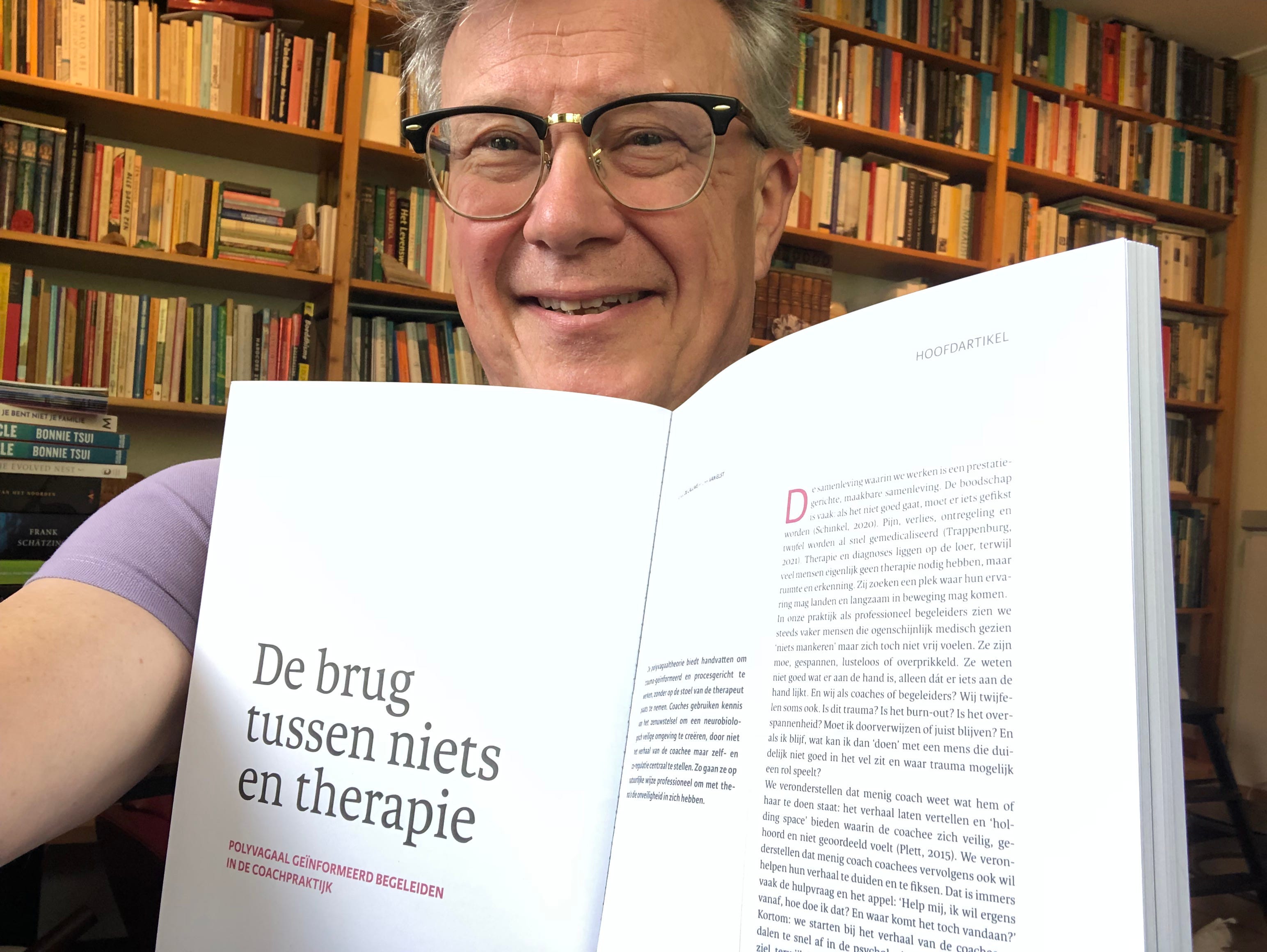
Polyvagal theory offers tools for working in a trauma-informed and process-oriented way, without taking the therapist’s seat. Coaches use knowledge of the nervous system to create a neurobiologically safe environment by centering self- and co-regulation rather than the coachee’s narrative. In this way, they naturally deal professionally with themes that involve insecurity.
The society in which we work is a performance-oriented, malleable society. The message is often, If things are not going well, something needs to be fixed (Schinkel, 2020). Pain, loss, disruption, and doubt are quickly medicalized (Trappenburg, 2021). Therapy and diagnoses are lurking, while many people do not actually need therapy but space and recognition. They are seeking a place where their experience can settle and slowly begin to move. In our practice as professional counselors, we increasingly see people who, from a medical perspective, appear to be ‘fine’ but who still do not feel free. They feel tired, tense, listless, or overwhelmed. They are not sure what is wrong, only that something appears to be wrong. And what about us as coaches or counselors? We sometimes have doubts too. Is this trauma? Is it burnout? Is it overwhelm? Should I refer them or stay? And if I stay, what can I ‘do’ with a person who is clearly not feeling well and where trauma may be playing a role?
We assume that many coaches know what to do: let them tell their story and offer ‘holding space’ in which the coachee feels safe, heard, and not judged (Plett, 2015). We assume that many coaches then also want to help coachees make sense of and fix their story. After all, that is often the request for help and the appeal: ‘Help me, I want to get rid of something; how do I do that? And where does it come from?’ In short, we start with the coachee’s story and too quickly descend into the psychological recesses of the soul, even though that is not our professional role. What if we were to involve physiology and unconscious bodily processes more consciously in our sessions?
In this article, we explore what coaches can achieve with physiological knowledge of polyvagal theory (Porges, 2011). In practice, this model has proven to be a workable framework that grounds our interventions. It has its origins in neuroscience and was initially applied mainly within trauma and psychotherapy practices (Porges, 2011; Dana, 2018). The theory provides language, insight, and scope for action in relation to what we sometimes already intuitively sense. We do not present ourselves as scientists but as practitioners. We explore how polyvagal theory can help professional counselors be present with their clients with greater confidence, gentleness, and somatic awareness. Because when viewed through a polyvagal lens, the question is not what happened, but what is happening here and now—in the body, in the space, in the relationship (Dana, 2020). The key question we are exploring is: how can a polyvagal-informed coach contribute to recovery, self-regulation, and meaningful movement—without it becoming therapy?
Polyvagal theory at a glance—a physical lens on human experience
Those who guide people always work with the body, even when the conversation remains entirely verbal. Polyvagal Theory (PVT), developed by psychologist and neuroscientist Stephen Porges (2011), offers an innovative and body-oriented perspective on how the autonomic nervous system constantly scans the world for safety and danger. More importantly, it shows how these unconscious processes determine what a person feels and thinks and how they behave. The theory does not provide counsellors with diagnoses, but rather a lens through which to understand behaviour and experience via the state of the nervous system.
Three Functional Systems
The autonomic nervous system (ANS) independently regulates those things that we do not need to use our minds for, such as body temperature, heart rate, breathing, digestion, pupil size, and other automatic processes that are vital to life. The ANS consists of the sympathetic part (activating, like a ‘gas pedal’) and the parasympathetic part (calming, like a ‘brake’). Examples include an accelerated heart rate during stress (sympathetic) and a slowed heart rate during relaxation (parasympathetic) (Bear, 2020).
Porges adds an extra layer to this in his polyvagal theory: he describes the ANS not as two, but as three functional systems that are organized hierarchically, based on evolutionary age. In response to unconscious assessments of (un)safety, the ANS shifts between three primary states (Porges, 2011; Dana, 2020):
Ventral vagal system: the evolutionarily youngest system, which focuses on social engagement and connection. This system becomes active when safety is experienced. People feel calm, connected, curious, and capable of social contact. In this state, they can reflect, play, learn, attune, and recover. When there is a mild threat—for example, someone looks angry after a comment—the ventral system can help prevent escalation by sending additional signals of connection and safety.
Sympathetic system: is older than the ventral part and comes to the fore in the event of threat or stress. The body prepares itself to fight or flee. People become alert, tense, angry, or anxious. Their focus narrows, and their connection with others diminishes. Even when safe, the sympathetic system can be activated. This creates sympathetic activation combined with connection, as we see in sports, play, and engaged work.
Dorsal vagal system: the oldest system. It becomes active when fighting or fleeing is no longer possible. This system switches to immobilization or freezing. People feel numb, withdrawn, powerless, or dissociative. In extreme forms, this leads to depressive or dissociative states (Dana, 2020). In safety, this system regulates our basic homeostatic processes, such as digestion and metabolism, and plays a vital role in our health.
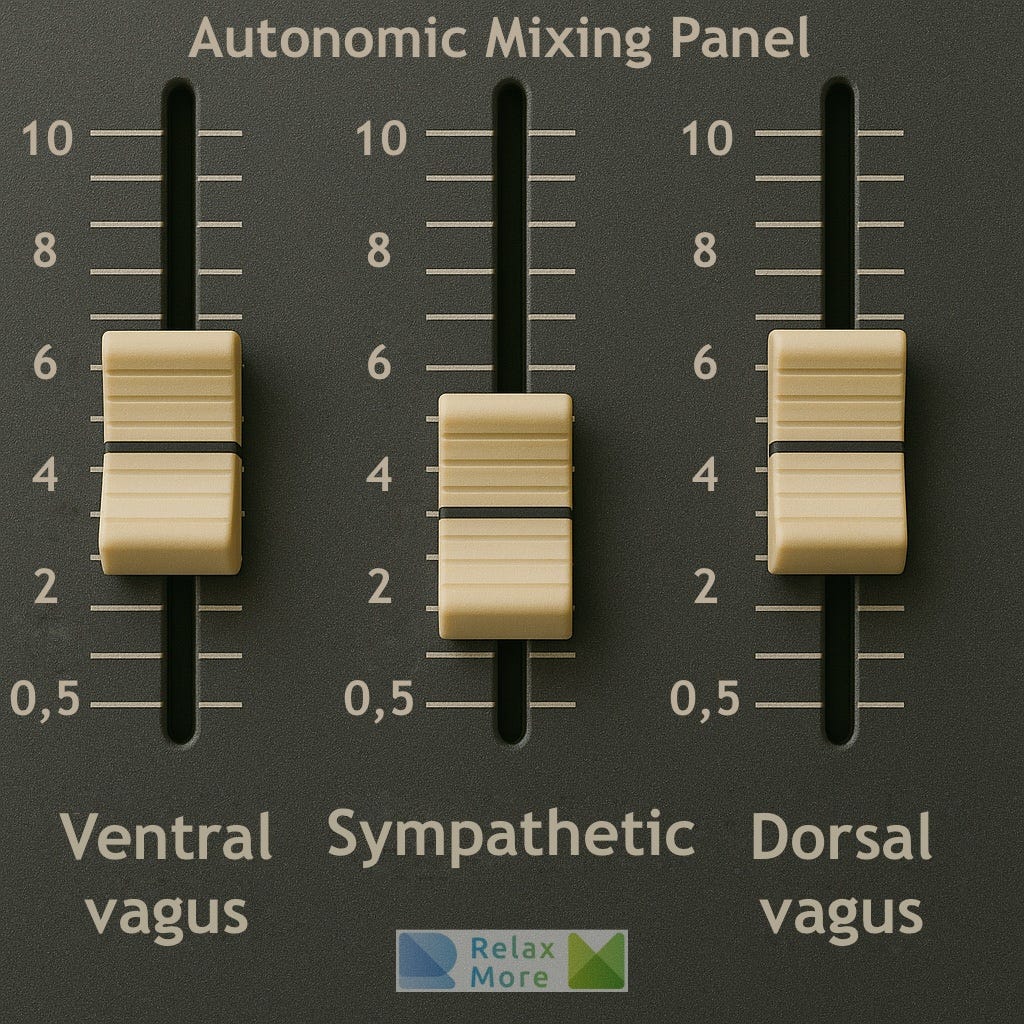
This classification is often represented as an ‘autonomic ladder’ (Dana, 2020). We automatically move up and down this ladder continually throughout the day, depending on what the body registers as safety or threat. Although the ladder is widely used, it has shortcomings, just like any model. We have chosen to use an autonomic mixing panel as a metaphor for the three autonomic states (de Caluwé 2025).
Neuroception
The detection of safety or threat occurs outside of conscious awareness. Porges introduced the term ‘neuroception’ for this: an automatic and non-cognitive process in which the nervous system continuously scans signals from the body (interoception), the environment (exteroception) and interactions with others (co-regulation) (Porges, 2004). This process occurs in the oldest brain structures, though the exact mechanisms remain unclear. Neuroception determines whether a situation is perceived as safe or unsafe, even before thoughts or interpretations arise.
Voice use (prosody), facial expression, body posture and movement, the layout of a room (including its scent), and signals from the body can influence this assessment (Dana, 2018). You can think of neuroception as the hand that operates the autonomic mixing panel.
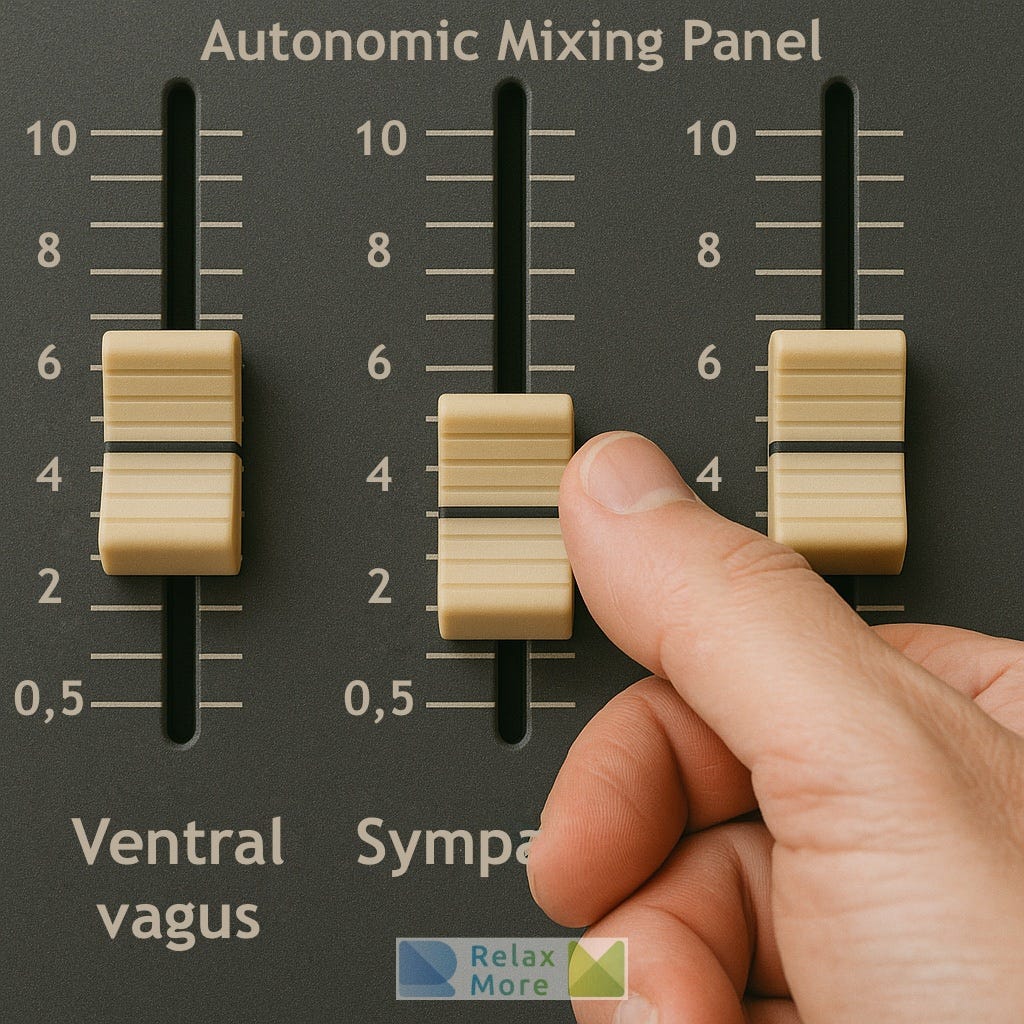
Our knowledge of neuroception provides coaches with a crucial tool for influencing autonomic states in their professional practice. This allows us to shift from psychological understanding to physiological comprehension.
Our bodies exist in an era for which they were not designed. Our nervous system and stress system are still the same as they were some 300,000 years ago. However, the amount of stress and stimuli has increased exponentially. Our ‘ancient’ stress system is unable to distinguish between physical danger (a sabre-toothed tiger chasing us) and psychological threat (a client sending a critical email).
A neuroception of unsafety increases the likelihood that our ventral vagus will be less active than ‘normal’—or more accurately, than what is natural and healthy. People with reduced ventral vagal tone experience diminished connection with others and have limited access to positive feelings, including (self-)compassion. Their learning ability also decreases.
Co-Regulation
Co-regulation is the effect of interpersonal interaction on the capacity to regulate one’s physiological state (bodily sensations and emotions). All relationships involving connection revolve around co-regulation. We learn to co-regulate in our early years, with the help of well-regulated parents or carers. Co-regulation is not a luxury; it is a biological requirement for our survival.
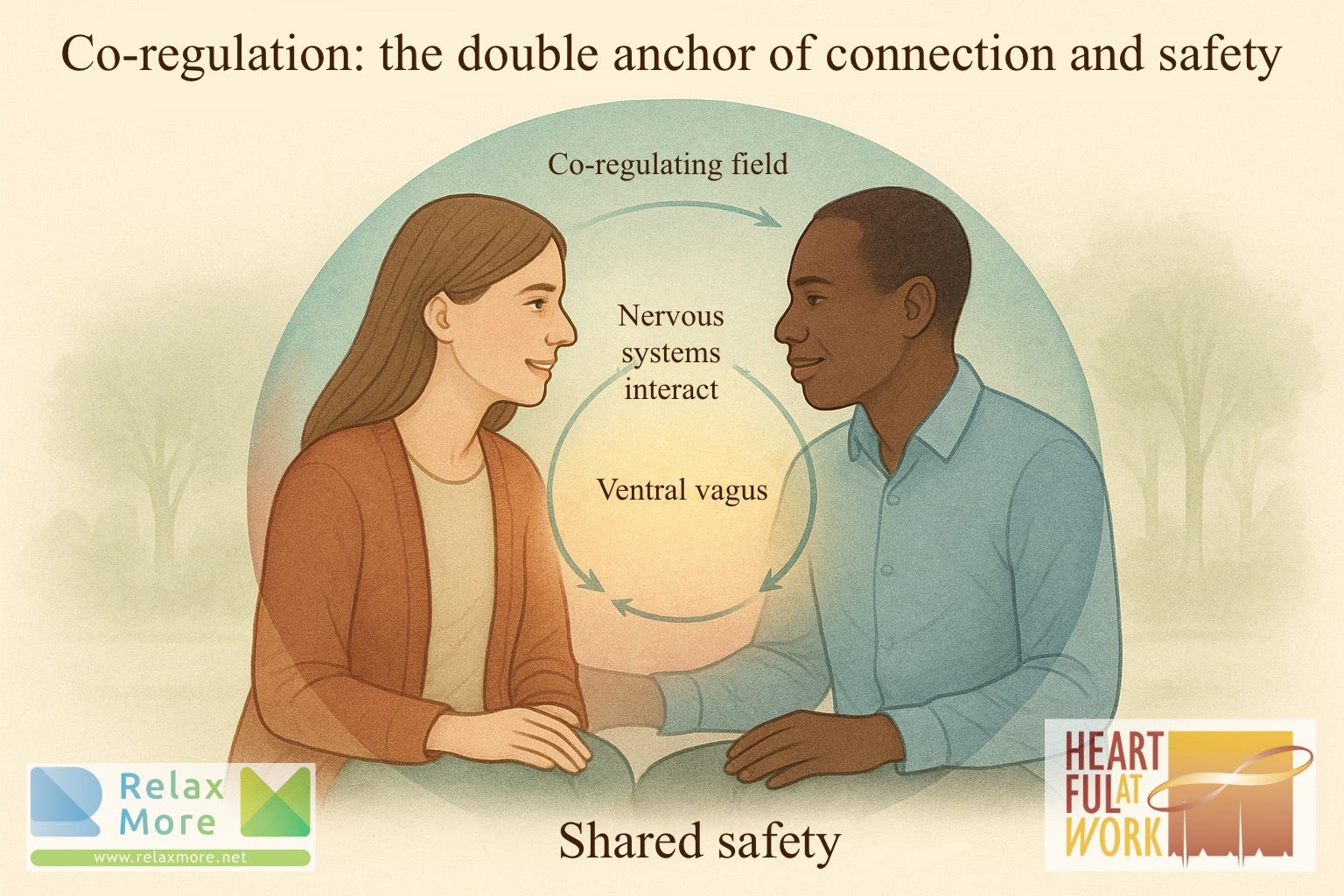
The need for human contact varies from person to person, but no one can do without it. People who claim they don’t need others likely live with a chronically activated nervous system.
As a coach or counselor, co-regulation means that you yourself serve as a regulatory instrument. Your tone, posture, speech, pace, and presence influence the state of your coachee’s nervous system and vice versa. Whether you invite connection or unintentionally evoke threat is largely registered somatically—not through rational reasoning.
If polyvagal theory can explain much of our behavior based on the functioning of the autonomic nervous system, then the theory is also relevant for coaches. For coaches, PVT-informed work means being consciously present with what emerges in the body and in the relationship, without analyzing or attempting to solve it. Because the nervous system does not want to be understood, it wants to be felt and encountered (Van der Kolk, 2014).
Example 1: Checking in
Marjan enters the practice hurriedly, her face red. “Phew, almost late,” she gasps, and sits down. “But I’m here!” She immediately begins her story about recent events. The coach notices that the coachee has clearly not yet landed (sympathetically activated) and indicates that it is important to check in first. “Breathe calmly and focus on your breathing.” Meanwhile, he counts her respiratory rate and notices it decreasing from 20 to 12 breaths per minute. He asks, “Are you more grounded now?” “Yes,” she says immediately. “Okay, Marjan, what do you want to talk about today?” Marjan immediately launches into her story.
In the above example, a lot seems to be going well. The coach notices the sympathetic activation (which was almost impossible to miss) and intervenes to help the coachee regulate so that the session time can be used effectively. However, signs suggest that Marjan remains sympathetically activated. The tone of her “Yes” is hurried, and she gets straight to the point. Activation to this degree means that the ventral part of the coachee’s autonomic nervous system may still be insufficiently active, preventing optimal connection and openness. That does not mean that the session cannot be valuable, but from a polyvagal perspective, a different start to the session would have been possible (please be patient; you are almost at example 2).
Applying polyvagal theory in a coaching session
Rather than responding immediately to the narrative content (’what happened?’), PVT invites us to first attune to the coachee’s physiological state (’what is the current setting of this person’s autonomic mixing panel?’). From this perspective, it becomes clear why one coachee talks actively and urgently (sympathetic activation), while another barely makes contact and appears absent (dorsal activation). Or why someone calms down when you, as coach, simply remain fully present without ‘doing’ anything (ventral regulation through co-regulation). What matters is that the coach offers connection without forcing the other person to connect as well. Any pressure on a trust-building process—which coaching fundamentally is—proves counterproductive. After all: if genuine trust exists, why would such pressure be needed? The coachee’s nervous system is often sensitive to this, especially in cases of trauma. The coachee might say something like, ‘I’m not very talkative today.’ However, this may be a rationalized explanation for an unsafe neuroception that arose because the coach unconsciously pressured the coachee. This can occur when the coach over-directs or absorbs the coachee’s arousal.
Slowing Down and Bearing With
The necessity of embodiment in the coach is therefore a key practical implication of PVT. In other words, as a coach, you are present not only cognitively but primarily through your body, breath, facial expressions, voice, and nervous system. You remain aware of your own state—even if slightly activated—provided you can ground yourself in it and slow down. Only a regulated nervous system can provide safety to another (Siegel, 2010).
Slowing down and bearing with are key concepts here: slowing down to notice what is happening somatically and bearing with to remain present with the other’s tension or discomfort without attempting to resolve it. This requires an attitude of ‘mutual inquiry’ (Epstein, 1999): exploring together, with curiosity, what the body is communicating, without judgment. ‘Mutual’ also implies ‘equal’—the coach need not have answers and must be able to abide in ‘not-knowing.’ Now we enter the ‘magical’ field where space can open, insights emerge, and discoveries unfold.

“Shut Up and Be Present!”
Co-regulation does not work through words, but through the relationship. The autonomic nervous system registers various safety signals that coaches can consciously employ. These include calm breathing, a warm vocal tone, and non-intrusive eye contact. This means that a simple coaching stance of silence and presence often proves more effective than any tool or technique (Dana, 2020).
The challenge for coaches is therefore not determining what to say or do, but rather how to be present. Am I regulated? Can I relate to the tension without taking it over, without pushing, without avoiding it?
Self-Regulation
Coaching from a polyvagal perspective means helping coachees recognize, normalize, and ultimately regulate their own autonomic responses. This requires coaches to develop somatic awareness, articulate physical sensations, and build experiential knowledge of ‘the mixing panel.’ Not through explanation alone, but through embodied experience, slowing down, and self-regulation. Self-regulation begins with learning to recognize signals: ‘When do I notice myself drifting, withdrawing, or accelerating?’ Co-regulation supports this process: through your attunement, presence, and calm, the other can re-experience safety. Only from that basis is reflection possible.
Example 2: Co-regulation
Marjan enters the practice hurriedly, her face red. “Phew, almost late,” she pants, and sits down. “But I’m here!” She immediately starts telling her story about recent events. The coach notices that the coachee has clearly not yet settled down (sympathetic activation) and also notices that this is affecting him; he experiences a restlessness that was not there a moment ago. He allows Marjan time to check in and breathe more calmly, then checks in with himself (slowing down). He consciously sits differently and breathes in and out calmly (slowing down, self-regulation). He notices himself calming down and can now look at Marjan with a gentle smile and ‘soft eyes’. Marjan says, “I’ve settled down now.” Nevertheless, he notices that Marjan still sits tensely, her eyes remain slightly widened, and her facial muscles appear somewhat ‘tight’. Moreover, her voice remains somewhat ‘elevated’, and her abdomen appears uninvolved in her breath. The activation has not really calmed down yet. “Okay,” says the coach, “I’m glad you feel you’ve settled, Marjan. How do you sense that in your body right now? Shall we explore that together?”
In this encounter, the coach invites the coachee to become curious and inhabit the here-and-now without hurrying (slowing down). The here-and-now is essential for connection and increased ventral vagal activation. A sense of calm emerges, creating space to explore the coaching question. Neither coach nor coachee knows where this will lead. But if the coach trusts that the coachee will discover insights and perhaps even answers, movement will emerge, allowing them to explore the question together from within the connection.
Traces of Trauma
Most coaches are not therapists. Yet it is virtually impossible for coaches not to encounter trauma. This is not because everyone is severely traumatized, but because trauma, broadly defined, is inherent to being human. In this example we don’t know whether a trauma part of Marjan was triggered, but her sympathetic activation could be related to this. Coaches speak of wounds, losses, shame, blockages, or unexplained reactions. These often contain traces of trauma, even if they are not identified as such.
The polyvagal theory also provides insight here and makes it possible to approach these themes without pathologizing or treating them. The nervous system’s response translates into behavior and aims to manage the situation as adaptively as possible. If someone could have avoided the freeze response through different means, they certainly would have. We won’t elaborate on what trauma is precisely, but we want to share Gabor Maté’s insight: ‘Trauma is not what happens to you, but what happens to you as a result of what happens to you.’
In example 2, we see that the coach creates an atmosphere of safety and connection, even though he does not know exactly what the underlying triggering problem is. From this position of not knowing, the coach can still slow down together with the coachee and create space so that the sympathetic activation can decrease. And then the coachee enters an entirely different session than in example 1.
Trauma-Sensitive Work
In our experience, many coaches recoil from signs of possible trauma dynamics: inexplicable reactions, intense emotions, avoidance behavior, ‘checking out,’ or freezing. Ien van der Pol wrote a clear guide for coaches on this topic: ‘I want the fear to disappear and for working with the effects of traumatic events to become more widely known among professional counsellors’ (Van der Pol, 2020). Practice reveals that the danger lies not in trauma’s content, but in how we engage with it. Attempts to fix, probe deeply, or accelerate can prove dysregulating (Van der Kolk, 2014; Van Elst et al., 2022). Repair implies something needs fixing—that something is ‘wrong’ with the coachee. In the ventral vagal state (calm, connection, and self-awareness, where nothing is ‘not-right’), both coach and coachee can welcome new perspectives and release old patterns (Dana, 2020).
A trauma-sensitive coach notices when the coachee becomes sympathetically or dorsally activated. The coach thus recognizes that the coachee’s autonomic nervous system detects something from the there-and-then in the here-and-now, triggering an unsafe neuroception and activating their survival mechanisms.
From a PVT-informed perspective, coaching focuses not on ‘repairing’ or resolving trauma, but on strengthening capacity for self- and co-regulation (containment). It is a fundamental way of supporting people in rediscovering their own movement, with the body as compass and the relationship as bedrock.
The coach as holding environment, not as solution machine
As we’ve seen, presence itself is physiological information. Rather than fixating on story or analysis, lived experience itself becomes the anchor of the coaching journey. This aligns with the polyvagal approach, in which the coachee’s state—not their story—guides the work. Hence the principle: ‘Story follows state’ (Porges, 2011).
This way of coaching requires not only knowledge of the nervous system but also ongoing self-reflection. The examples reveal how coaches can sometimes get swept up in their own survival responses: fixing, avoiding, over-regulating, and filling in gaps. Coaches can only provide a safe bedrock if they know themselves and can access their own ventral state. Professional coaches therefore work in trauma-informed and process-oriented ways but do not process trauma unless specifically trained to do so. Concretely, this means that training programs for professional coaches must invest not only in methodology but also in:
(Neuro)physiological knowledge;
Somatic awareness and interoception;
Self-regulation skills;
Knowledge of trauma responses;
Creating space for trauma-sensitive reflection;
Embodied learning, not just theoretical knowledge.
Fortunately, several such training programs in the Netherlands are recognized by the LVSC (Dutch National Association for Supervision and Coaching).
In a world where stress, burnout, and disconnection seem more the rule than the exception, coaching has become an in-between practice. Not therapy, not nothing, but something that moves in the space between. It is precisely in this space that polyvagal theory offers a workable lens: a way of seeing people that requires not diagnosis, but presence. This enables us to work with people who might otherwise benefit from therapy.
Key Element
When coaching people, you always work with the autonomic nervous system—whether aware of it or not. That is the central conclusion of this article. PVT-informed coaching means not treating trauma but learning to recognize someone’s autonomic state and how to offer safety at the nervous system level. This demands a fundamental shift in coaching practice:
From analyzing to attuning: story follows state, not the reverse.
From solving to regulating: you need not fix anything but must be able to hold and bear with it.
From method to humanity: your presence is often your most powerful instrument.
Especially in our current era, when existential discomfort is often medicalized, coaches need language for life’s inherent pain, whether large or small. Language that normalizes rather than pathologizes. Polyvagal theory offers such language: practical, somatic, and relational. In this article, we have shown what that can look like. Coaches who work in a PVT-informed way:
Recognize signs of autonomic activation;
Can slow down rather than speed up;
Can remain present without ‘doing’;
Create space where regulation and healing can emerge, without directing.
These four capacities can be trained but demand an integrated, embodied foundational stance. The key lies in the coach’s fundamental trust that open exploration of an issue or question offers the greatest possibility for a fruitful session. In our view, coaches need more training in stress and autonomic nervous system physiology, self-awareness to recognize their own signs of autonomic activation, and supervision grounded in PVT-informed practice.
The authors will offer several masterclasses on ‘Polyvagal-informed and embodied coaching’ in 2026.
More information is available at www.relaxmore.net and www.heartfulatwork.nl.
You can download a PDF of the article:

Authors:
Ronald de Caluwé (1963) engages in compassionate bodywork through mindfulness, tai chi, and qigong. He is fascinated by polyvagal theory, writes about it regularly, and is a board member of the Dutch Polyvagal Institute. Website: www.relaxmore.net. Email: ronald@relaxmore.net.
Cees van Elst (1962) is an LVSC-registered coach working for the Academy for Medical Specialists. He is the owner of ‘HeartfulAtWork Coaching & Consultancy’ and a board member of the Dutch Polyvagal Institute. Website: www.heartfulatwork.nl. Email: cees.van.elst@heartfulatwork.nl.
References:
Bear, M. F., Connors, B. W., & Paradiso, M. A. (2020). Neuro-science: Exploring the Brain (4e editie). Wolters Kluwer.
Dana, D. (2018). The polyvagal theory in therapy: Engaging the rhythm of regulation. W. W. Norton & Company.
Dana, D. (2020). De polyvagaaltheorie in therapie: Het ritme van regulatie. [The polyvagal theory in therapy: Engaging the rythm of regulation]. Mens!
De Caluwé, R. (2025). Een nieuwe samenvatting van de polyvagaaltheorie. [A New Overview of Polyvagal Theory]. Online: https://www.relaxmore.net/p/een-nieuwe-samenvatting-van-de-polyvagaaltheorie.
Epstein, R. M. (1999). Mindful practice. JAMA, 282(9), 833–839.
Grossman, P., & Taylor, E. W. (2007). Toward understanding respiratory sinus arrhythmia: Relations to cardiac vagal tone, evolution and biobehavioral functions. Biological Psychology, 74(2), 263–285.
Plett, H., Smit, M. & Elstak, P. (2021) De kunst van Holding Space: Lessen in liefde, loslaten en leiderschap. [The art of Holding Space: lessons in love, letting go and leadership]. Het Noorderlicht.
Porges, S. W. (2004). Neuroception: A subconscious system for detecting threats and safety. Zero to Three, 24(5), 19–24.
Porges, S. W. (2011). The polyvagal theory: Neurophysiological foundations of emotions, attachment, communication, and selfregulation. W. W. Norton & Company.
Schinkel, W. (2020). De nieuwe democratie: Naar andere vormen van politiek. [The new democracy:towards alternative forms of politics]. Boom.
Siegel, D. J. (2010). The mindful therapist: A clinician’s guide to mind-sight and neural integration. W. W. Norton & Company.
Trappenburg, M. (2021). De zorgval. [The healtcare trap]. Boom.
Van der Kolk, B. A. (2014). The body keeps the score: Brain, mind and body in the healing of trauma. Viking.
Van der Pol, I. G. M. (2020). Coachen waar het pijn doet: Werken met trauma in coaching en begeleiding. [Coaching where it hurts: working with trauma in coaching and guidance]. SWP.
Van Elst, C., Van Rijssel, M., & Smit, L. (2022). Van vermijding naar bevrijding: Drie coachingswegen naar Zijn. [From avoidance to liberation: three coaching pathways toward embodied Presence]. Samsara.